
When the Book Itself Is the Story
There’s a version of rare book collecting that’s almost purely numerical. A first edition of The Great Gatsby matters because it was one of a specific number printed in 1925, because Fitzgerald’s name appears on the title page, because bibliographers have documented its points and issue sequence for a century. The cultural significance is real, but it’s distributed, shared across every copy that rolled off the press that year.
Then there’s a different kind of value entirely. A copy of The Great Gatsby that Fitzgerald gave to his editor Maxwell Perkins, with a note in the margin where Perkins pushed back on a line, that book is singular. Not one of thousands. One of one. Its value isn’t bibliographic. It’s human.
This distinction sits at the heart of what I find most compelling about the books that come through Collectors Annex.
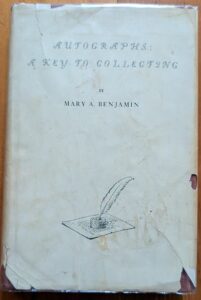
Recently I’ve been deepening my study of autographs and association copies, the vocabulary, the history, the market. I ordered a few reference books, including Autographs: A Key to Collecting by Mary A. Benjamin, first published in 1946 and still considered a foundational text in the field. Benjamin wasn’t just a writer on the subject, she was one of its most respected practitioners, running the Walter R. Benjamin Autographs dealership in New York for decades, a business her family had operated since 1887. She knew the value of a signature, an inscription, a human trace on a page, better than almost anyone.
The copy I received from ThriftBooks had seen better days. The dust jacket was tattered, so I stabilized the reverse side with filmoplast and added a mylar sleeve. But when I opened the front pages, I found this:
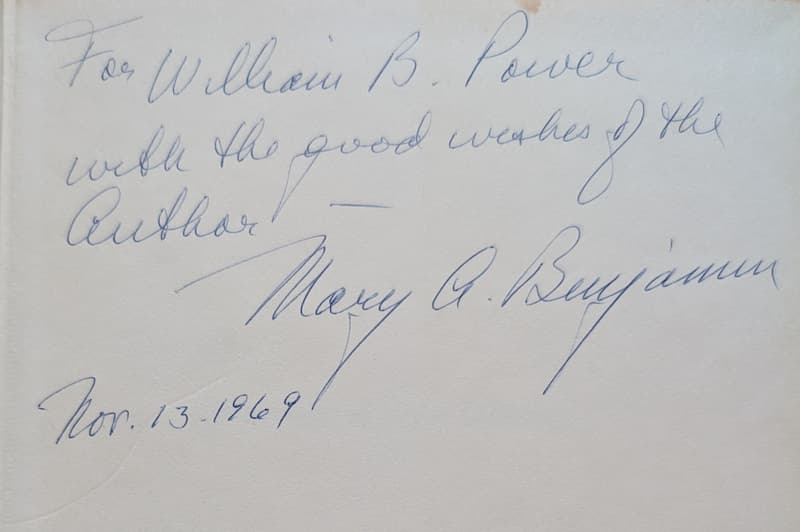
To William B. Power With the good wishes of the author Mary A. Benjamin Nov 13, 1969
A book about the significance of inscriptions. Inscribed by its author.
I’ve been unable to identify William B. Power with certainty, he may have been a fellow dealer, a serious collector, someone in Benjamin’s professional circle. That uncertainty is itself a small lesson: association copies don’t always come with complete stories. Sometimes the human trace is there, and the rest is silence.
Which brings me back to the thesis. The most valuable books aren’t always the ones with the most zeros in the auction catalog. They’re the ones that carry evidence of a life, a relationship, a moment, a hand that held a pen and thought of someone specific. Mary Benjamin understood this. She built a career on it. And somehow, a worn copy of her book traveled from her hand in 1969 to my desk in 2026, still carrying that evidence.
I’m not planing to sell this book. It’s now the centerpiece of my bookselling reference library, a reminder of exactly what I’m looking for when I open a box of estate books.