
The Convergence of Nigerian Modernism and African-American Artistic Life
I’m a frequent shopper at McKay’s bookstore in Mebane, North Carolina, and earlier this year, an oversized art book caught my eye. It was a monograph on the Nigerian modernist printmaker Bruce Onobrakpeya, published in 2002 by the Ford Foundation. The dust jacket was clean, the binding tight, and the pages crisp. That was enough to make it worth a closer look. What I found inside made me put everything else down.
Affixed into the preliminary pages was an original 3×5 photograph, a physical print, not a reproduction. Tucked inside was an oversized promotional mailer from the Chrysler Museum of Art in Norfolk, dated April 2004, advertising a lecture called “Verifying the African Presence.” And on the front endpaper, in firm, deliberate ink:
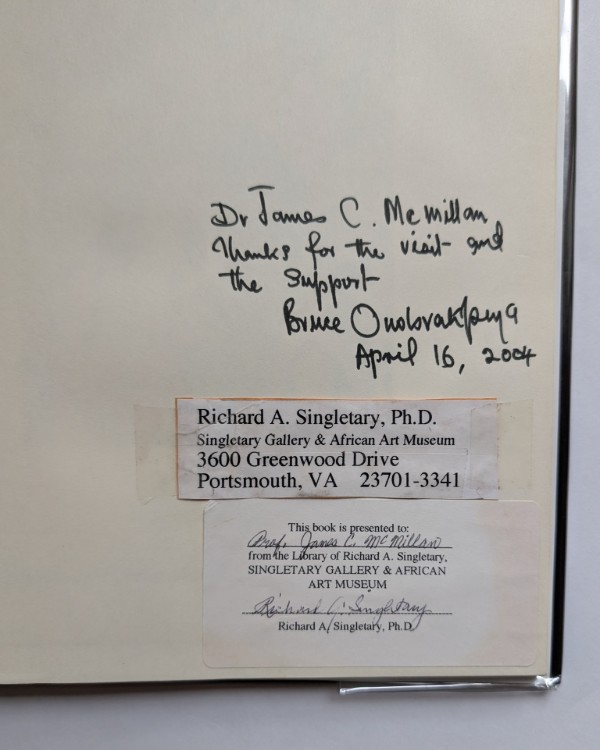
Dr. James C. McMillan
Thanks for the visit and the support
Bruce Onobrakpeya
April 16, 2004
The subject of the book had signed it to its recipient. That alone was remarkable. But there was a second layer.
Tipped in alongside the photograph was an institutional address card for the Singletary Gallery & African Art Museum in Portsmouth, Virginia, and a presentation plate in a second hand:
This book is presented to
Prof. James C. McMillan
from the Library of Richard A. Singletary
Singletary Gallery & African Art Museum
Richard A. Singletary
The author had presented this book from his personal library to the same man.
Digging Deeper
Three names. One date. One room somewhere in coastal Virginia, on April 16, 2004.
Bruce Onobrakpeya (b. 1932) is one of the defining figures of Nigerian modernism. A founding member of the Zaria Art Society — the movement that broke with colonial academic painting and insisted on an authentically African visual language — he went on to invent his own techniques: the plastograph, the bronze lino relief. He has been the subject of major retrospectives, including a prominent position in the landmark Nigerian Modernism survey at Tate Modern. His auction record stands above $80,000. In 2006 he received the UNESCO Living Human Treasures Award. In 2024, the US-Nigeria Lifetime Achievement Award.
Dr. Richard A. Singletary (1940–2025) was an American scholar of African art whose doctoral dissertation at Virginia Commonwealth University formed the scholarly foundation of this very monograph, commissioned directly by the Ford Foundation. He founded the Singletary Gallery & African Art Museum in Portsmouth — a private institution dedicated to African and African-American visual culture. This book came from his personal library. He gave it away, with a handwritten inscription, to a colleague he thought should have it.
Dr. James C. McMillan (1926–2022) was a sculptor, painter, and educator whose career was inseparable from the civil rights movement in North Carolina. He studied at Howard University under Alain Locke — the philosopher of the Harlem Renaissance — and later at the Académie Julian in Paris. He became the first full-time Black professor and Art Department Chair at Guilford College in Greensboro, a post that carried enormous institutional weight in a city still formally segregated at the time. He was jailed three times for nonviolent civil disobedience. He co-founded the African American Atelier in Greensboro, an institution that continues to operate today.
When McMillan died in Greensboro in 2022, and Singletary in 2025, their libraries dispersed into the regional estate market. This book somehow made its way, by whatever route, thirty miles down the road to Mebane.
What happened on April 16, 2004
Two days before the Chrysler Museum lecture, Onobrakpeya and McMillan met. The mailer tucked inside the book, advertising “Verifying the African Presence” on April 18 , dates the weekend precisely. Singletary, whose gallery was in Portsmouth, was in all likelihood the connective tissue for the weekend: the host, the intermediary, the man who brought a Nigerian master and a North Carolina civil rights artist into the same room.
What the inscription records is not a retail signing. Onobrakpeya did not sign a copy someone bought at a table. He wrote a personal thanks, for the visit and the support, directly to McMillan, in a book that Singletary had simultaneously pulled from his own library and presented as a gift. Three men, on the same day, completing a transaction that was as much about solidarity and recognition as it was about a book changing hands.
The promotional mailer stayed inside. It wasn’t forgotten, it was left there on purpose, or carried forward without anyone thinking to remove it. Either way, it survived. It fixes the timeline in physical form.
Provenance chain
2002: Onobrakpeya published by the Ford Foundation / Institute of International Education. Richard A. Singletary’s dissertation forms the monograph’s scholarly basis. A copy enters his personal library.
April 16, 2004: Singletary presents his personal copy to Dr. James C. McMillan with handwritten inscription. On the same day, Bruce Onobrakpeya inscribes the front endpaper to McMillan personally: Thanks for the visit and the support.
April 18, 2004: Bill Forbes delivers a lecture “Verifying the African Presence” at the Chrysler Museum of Art, Norfolk, VA, documented by the oversized promotional mailer retained inside the volume.
2022: Dr. James C. McMillan dies in Greensboro, NC. His estate disperses into the regional market.
2025: Dr. Richard A. Singletary dies. His gallery and library dispersed.
2025–2026: The volume surfaces at an independent bookstore in Mebane, NC, approximately thirty miles from the McMillan estate in Greensboro, preserving the geographic integrity of the chain of custody.
What These Inscriptions Preserve
Standard trade copies of this monograph, signed by Onobrakpeya alone, sell in the $150–$225 range on the antiquarian market. What this copy carries is categorically different.
It is a documented, dated, multi-party record of a real meeting , a West African modernist master, an American Africanist scholar, and a North Carolina civil rights artist, in the same room, exchanging a book on the same afternoon. The ephemera inside doesn’t supplement the inscriptions; it anchors them. The tipped-in photograph is original. The address card establishes the institutional geography. The promotional mailer names the weekend. The inscriptions name the people.
As a work of Nigerian modernist scholarship, the book belongs to a field now receiving serious institutional attention. As an association copy, it documents a specific node in the transatlantic Black cultural network of the early 2000s. As an artifact, it arrived intact, binding, cloth, pages, and provenance, from the estate of a man who knew exactly why he was keeping it.
Full provenance documentation is available for serious buyers and institutions upon request.